AI Isn't Racist on Its Own. It Learned It From Us.

Ask a modern AI chatbot about race and you’ll usually get a careful, kind, balanced answer. It has been trained to give one.
That answer is real. It’s also not the whole story.
AI doesn’t come from nowhere. It’s built by feeding a computer an enormous pile of things people wrote: books, articles, forums, comments, old records. It learns how we talk, and along the way it learns what we assume. Our opinions and our biases come along for the ride.
So this post isn’t a list of things to fix. It’s one thing to keep in mind. When an AI answers you, it’s answering with a lot of people’s habits of mind, not a neutral view from nowhere.
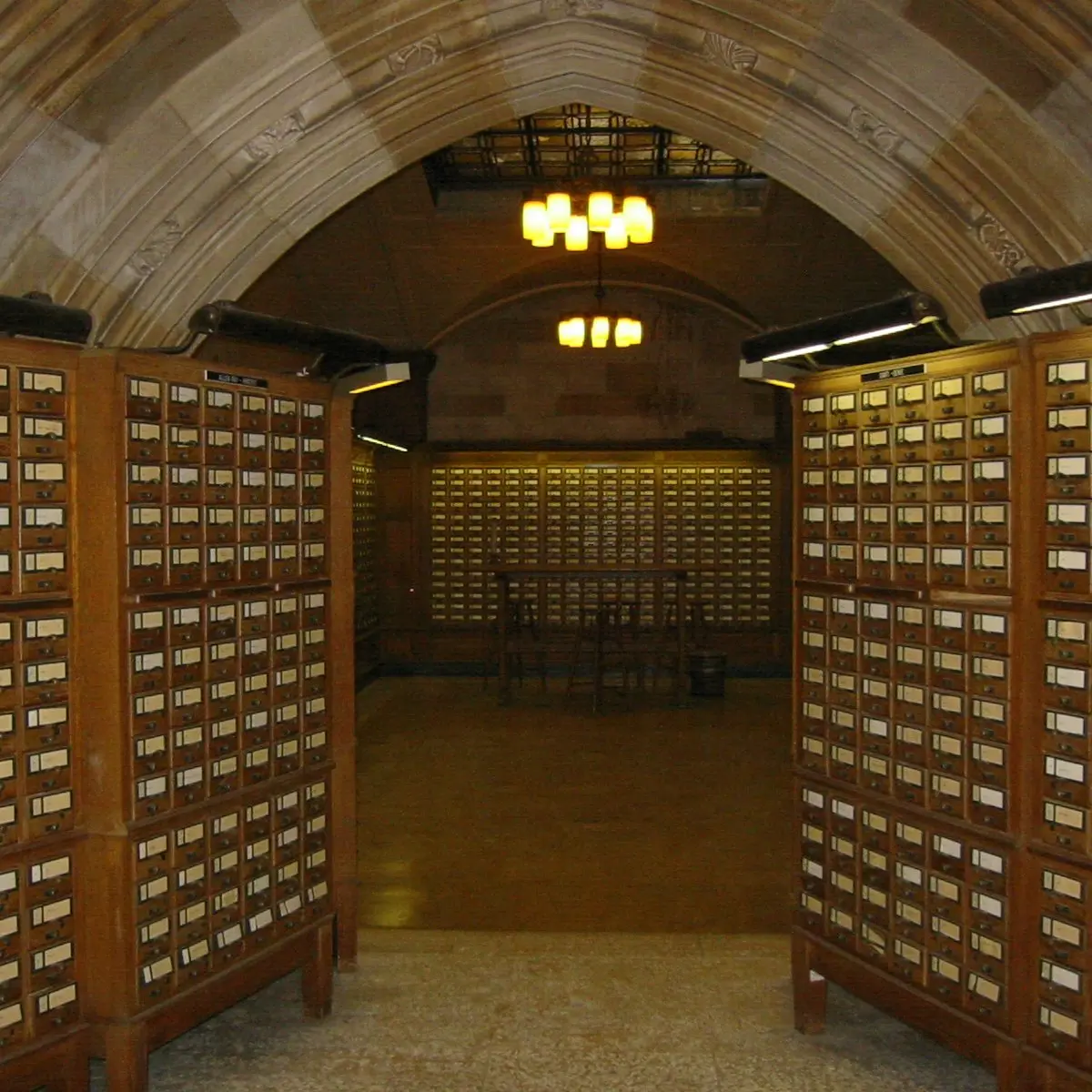
Everything we ever filed, labeled and wrote down, including the parts we’d rather not have. Photo: card catalog drawers at Yale’s Sterling Memorial Library, 2006, public domain (Wikimedia Commons).
This started with people
Bias in hiring isn’t an AI invention. In a well-known experiment published in 2004, economists Marianne Bertrand and Sendhil Mullainathan sent made-up résumés to real job ads in Boston and Chicago. The résumés were the same except for the name at the top. Names that sounded white got 50 percent more callbacks for interviews than names that sounded Black.
Nobody in that study was a computer. That’s the material AI learns from: the world as people actually behaved in it.
What it looks like in AI
Researchers have now tested AI the same way, and the pattern shows up again.
Résumés. In 2024, Kyra Wilson and Aylin Caliskan at the University of Washington had three AI models rank more than 550 real résumés against more than 500 real job listings, changing only the names. White-sounding names were favored 85% of the time. Black-sounding names, 9%. In their tests, a Black man’s name was never picked over a white man’s.
The way you talk. A 2024 study in Nature by Valentin Hofmann and colleagues gave AI models the same statements written two ways: in African American English (the dialect many Black Americans speak) and in Standard American English. Race was never mentioned. Asked to rule on a made-up court case using only that statement, the models convicted more often (68.7% vs 62.1%) and chose the death penalty more often (27.7% vs 22.8%) when the words were in African American English.
Hospitals. A 2019 study in Science looked at a type of algorithm that helps decide care for over a hundred million Americans. It used past health spending to guess who was sickest. But less money has historically been spent on Black patients who are just as sick, so the algorithm ranked them as healthier than they were. Fixing that would have raised the share of Black patients picked for extra help from 18% to 47%.
None of these systems was told to treat anyone worse. They learned it.
The polite answer hides the rest
Here’s the part that matters most for everyday use. In the Nature study, the researchers also checked what happens when AI is trained to give better answers, using people’s ratings of its replies. That training made the AI’s open statements about Black people much friendlier. It did nothing to the hidden ones. The authors’ own words: it “obscures the racism on the surface, but the racial stereotypes remain unaffected on a deeper level.”
That’s why a nice answer when you ask about race doesn’t tell you much. The real test is what the AI does when race isn’t the topic: who it ranks first, how it reads a message, what it assumes. (Earlier posts here covered a related habit: AI is trained to tell you what you want to hear, and it sounds just as sure when it’s wrong.)
The fair counterpoint: measuring it works
It would be easy to stop at “AI is racist” and walk away. That’s not quite right, and it’s not useful.
The bias is in us first. And unlike us, AI can be tested at scale, out in the open, again and again. When it is, things change. In 2018, Joy Buolamwini and Timnit Gebru tested three companies’ face-analysis tools on 1,270 faces. The tools were nearly perfect on lighter-skinned men and badly wrong on darker-skinned women.
How to read this: each row is one company's tool. The gap between the two dots is the difference in mistakes between the two groups. Faces came from 1,270 photos of members of parliament from six countries. Source: Buolamwini & Gebru, "Gender Shades," 2018, Table 4.
Then the results were published, with the companies named. Within seven months, all three released new versions, and their error rate on darker-skinned women dropped by 17.7% to 30.4%, according to a 2019 follow-up. Most of the time nobody set out to build something unfair. Nobody had checked.
What I’d ask you to do: just remember
You don’t need to stop using AI, and you don’t need to audit it yourself. Just keep its origin in mind, the way you would with any advice from a stranger who read the whole internet.
That matters most when AI is helping decide something about a person: who to interview, how to read a customer’s message, which complaint sounds serious. Those are the moments when “it learned from us” stops being an idea and starts being someone’s outcome.
I’d like to hear from you. Have you seen an AI tool make an assumption about someone that a thoughtful person wouldn’t? Tell me in the comments.
Sources
- Bertrand, M. & Mullainathan, S. (2004). Are Emily and Greg More Employable Than Lakisha and Jamal? American Economic Review.
- Wilson, K. & Caliskan, A. (2024). AI résumé screening study, via University of Washington News, Oct. 31, 2024.
- Hofmann, V., Kalluri, P. R., Jurafsky, D. & King, S. (2024). AI generates covertly racist decisions about people based on their dialect. Nature 633, 147–154.
- Obermeyer, Z. et al. (2019). Dissecting racial bias in an algorithm used to manage the health of populations. Science. Summary: UC Berkeley News, Oct. 24, 2019.
- Buolamwini, J. & Gebru, T. (2018). Gender Shades. Proceedings of Machine Learning Research 81.
- Raji, I. D. & Buolamwini, J. (2019). Actionable Auditing. MIT Media Lab.
 JobKick support

Comments
Loading comments…